



Posted By SEO Root

22 mins

11/18/2026
What Is Standing Seam Roofing? Materials, Types & Uses
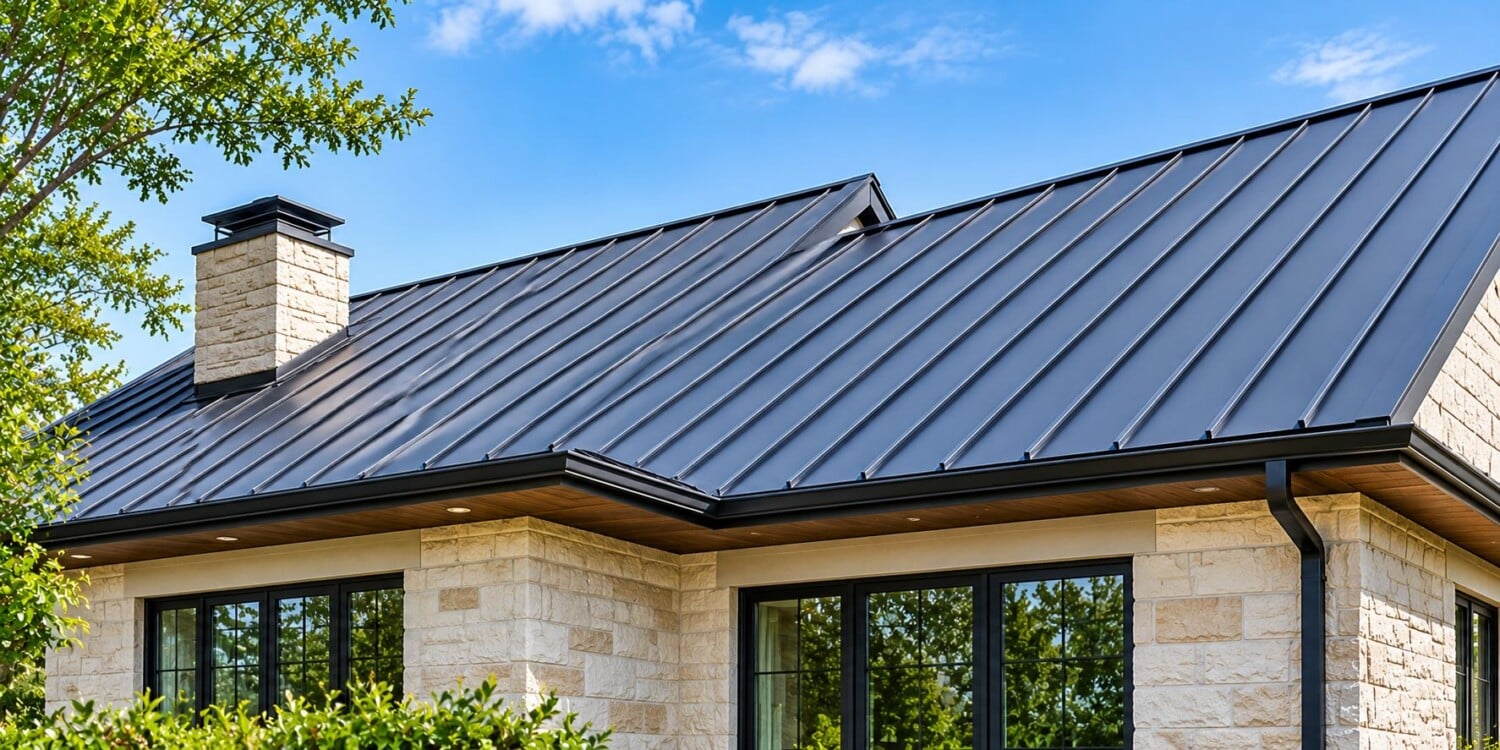
Metal roofing is available in several styles, but standing seam metal roofing stands out for its raised panel connections, concealed fasteners, and clean appearance. It is commonly used on modern homes, traditional houses, commercial buildings, and architectural projects where durability and appearance both matter.
Understanding these differences can help you make a more informed decision before investing in a new roof. Below, we’ll explain how standing seam roofing works, compare its different types, discuss its benefits and limitations, and explore what Syracuse homeowners should consider before choosing this roofing system.
What Is Standing Seam Roofing?
A standing seam metal roof is made of long, continuous metal panels joined by raised vertical seams that run from the ridge toward the eaves. Concealed clips or fastening flanges hold the panels down, and the adjoining panel covers them. Unlike exposed-fastener metal roofing, no screws pass through the visible surface.
Its main parts include:
- Metal panels: Long sheets of steel, aluminum, or another approved roofing metal that form the main roof surface.
- Raised seams: Vertical connections that join adjacent metal panels.
- Clips or fastening flanges: Components that secure the panels to the roof deck.
- Underlayment: A protective layer installed between the roof deck and metal panels.
- Flashing: Metal pieces installed around chimneys, skylights, valleys, walls, and roof edges to direct water away from vulnerable areas.
- Ridge and eave details: Components that finish the roof edges and help manage water and ventilation requirements.
The exact construction depends on the selected standing seam profile and the manufacturer’s installation specifications.
How Does a Standing Seam Metal Roof Work?
A standing seam roof connects metal panels through interlocking raised edges, so concealed fasteners hold them in place instead of exposed screws.
- Panels go side by side. Each panel aligns with the next across the roof deck.
- Concealed clips secure them. The panel edges cover the clips, keeping most screws hidden.
- Raised seams connect the panels. The edges either snap together or are folded with a seaming tool.
- Panels move with temperature. Floating clips let the metal expand and contract without stressing the fasteners.
- Water drains to the eaves. The raised seams sit above the flow, and proper flashing, underlayment, and roof detailing still protect against leaks.
What Are the Different Types of Standing Seam Metal Roofing?
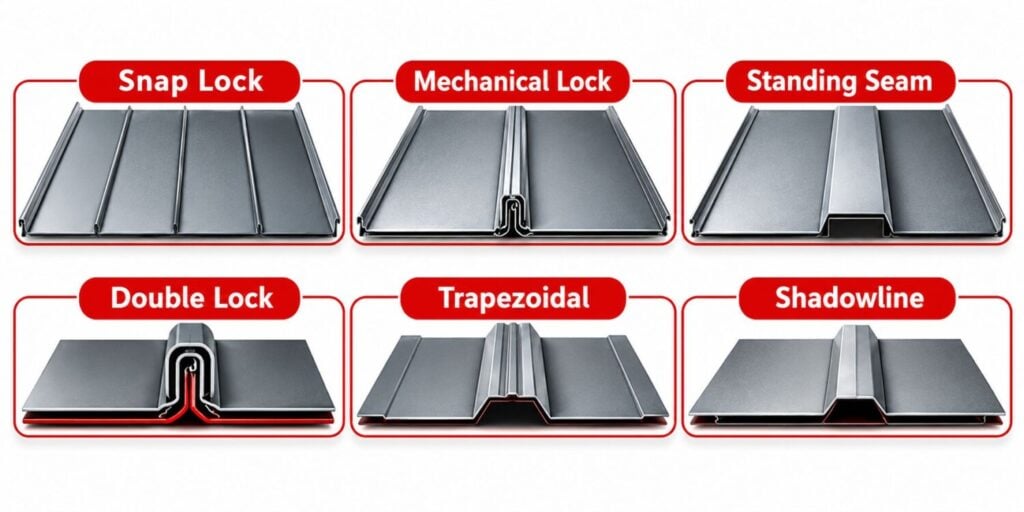
Standing seam metal roofing and related metal panel systems come in several designs. They mainly differ in how the panel edges connect, how the seams are secured, and how the panels attach to the roof deck.
Understanding the available metal roofing profiles helps you compare installation requirements, weather resistance, appearance, and determine which system is appropriate for your roof.
1. What Is a Snap-Lock Standing Seam Metal Roof?
A snap-lock standing seam roof uses specially shaped panel edges that fit together when pressed into place. One panel’s raised edge connects with the adjoining panel, creating a locked seam without requiring a separate mechanical seaming operation.
These panels typically use concealed clips or a compatible fastening arrangement to secure them to the roof deck.
Main characteristics:
- Raised seams that snap together.
- Concealed fastening points.
- No separate powered seaming process.
- Generally faster installation than mechanically seamed systems.
- Commonly used on residential roofs with suitable slopes.
When is snap-lock roofing suitable?
Snap-lock panels are often selected for residential roofs with adequate slopes and standard architectural designs. Many products require a minimum slope around 3:12, but this is not a universal requirement. The manufacturer’s specifications determine the acceptable roof pitch.
2. What Is a Mechanically Seamed Standing Seam Metal Roof?
A mechanically seamed metal roof uses a specialized hand tool or powered machine to fold the edges of adjoining panels together after installation.
This process creates a secure connection between neighboring panels. Mechanically seamed systems are commonly considered for projects that require specific weather-tightness, wind performance, or low-slope compatibility.
Main characteristics:
- Panel edges are mechanically folded together.
- Creates a secure interlocking seam.
- Uses specialized hand or powered seaming tools.
- Can accommodate certain low-slope roofing applications.
- Requires skilled installation.
When is mechanically seamed roofing suitable?
Mechanically seamed roofing is often selected for commercial, industrial, and residential projects where the roof design requires a mechanically secured panel connection. The appropriate seam configuration depends on roof slope, weather exposure, and manufacturer specifications.
3. What Is a Batten Standing Seam Metal Roof?
A batten standing seam roof uses separate metal caps to cover the connections between neighboring panels.
Instead of forming the seam entirely through interlocking panel edges, this system places a raised cap over the adjoining edges. The cap creates a distinctive vertical appearance across the roof.
Main characteristics:
- Separate metal caps cover panel connections.
- Creates prominent raised seams.
- Offers a distinctive architectural appearance.
- Available in different cap profiles and designs.
- Can accommodate different architectural roofing styles.
Two common variations include:
- Snap-cap batten: A separate metal cap snaps over the adjoining panel edges.
- Tee-seam: A specially shaped metal cap covers the panel connections, creating a distinctive raised profile.
When is batten roofing suitable?
Batten-style systems are often selected for architectural projects where the roof’s appearance is an important consideration. Their suitability depends on the roof design, panel configuration, and manufacturer’s system details.
4. What Is a Double-Lock Standing Seam Metal Roof?
A double-lock standing seam roof uses a mechanically folded connection in which the adjoining panel edges are folded twice, creating an approximately 180-degree connection.
This additional fold creates a tightly secured seam and is commonly specified for certain low-slope roofing applications.
Main characteristics:
- Double-folded panel connections.
- Approximately 180-degree seam configuration.
- Provides an additional folded connection.
- Requires specialized seaming equipment or tools.
- Commonly used in commercial and architectural roofing projects.
When is double-lock roofing suitable?
Double-lock systems are often considered for roofs that require a mechanically secured seam and specific weather-tightness performance. They can be suitable for certain low-slope applications, provided the panel system is approved for the roof pitch and installation conditions.
5. What Is Trapezoidal Metal Roofing?
Trapezoidal metal roofing uses panels with raised ribs that have a distinctive trapezoid-shaped profile. These ribs run vertically along the roof surface, creating a structured appearance while adding rigidity to the panels.
Unlike traditional standing seam panels, trapezoidal profiles can use different fastening arrangements depending on the product design.
Main characteristics:
- Prominent trapezoid-shaped raised ribs.
- Provides additional panel stiffness.
- Available in different rib heights and spacing.
- Can use concealed or exposed fastening systems.
- Commonly used for commercial, industrial, and agricultural buildings.
When is trapezoidal metal roofing suitable?
Trapezoidal metal panels are often selected for larger roof areas where structural performance, practical installation, and durability are important considerations. The appropriate profile depends on the building design, structural requirements, roof slope, and manufacturer’s specifications.
6. What Is Shadowline Metal Roofing?
Shadowline metal roofing features raised panel joints designed to create distinctive shadow lines across the roof surface. The profile gives the roof a clean, architectural appearance while adding depth and definition to the overall design.
Depending on the manufacturer, shadowline profiles may use different seam configurations and fastening arrangements.
Main characteristics:
- Distinctive raised panel joints.
- Creates consistent shadow lines across the roof.
- Offers a clean, contemporary architectural appearance.
- Available in different panel widths and profiles.
- Designed for specific concealed or compatible fastening systems.
When is shadowline metal roofing suitable?
Shadowline profiles are often considered for modern residential and commercial buildings where the appearance of the roof is an important design feature. The final selection should account for the roof pitch, weather exposure, fastening requirements, and manufacturer’s installation specifications.
What Is the Difference Between Snap-Lock and Mechanical Seam Roofing?
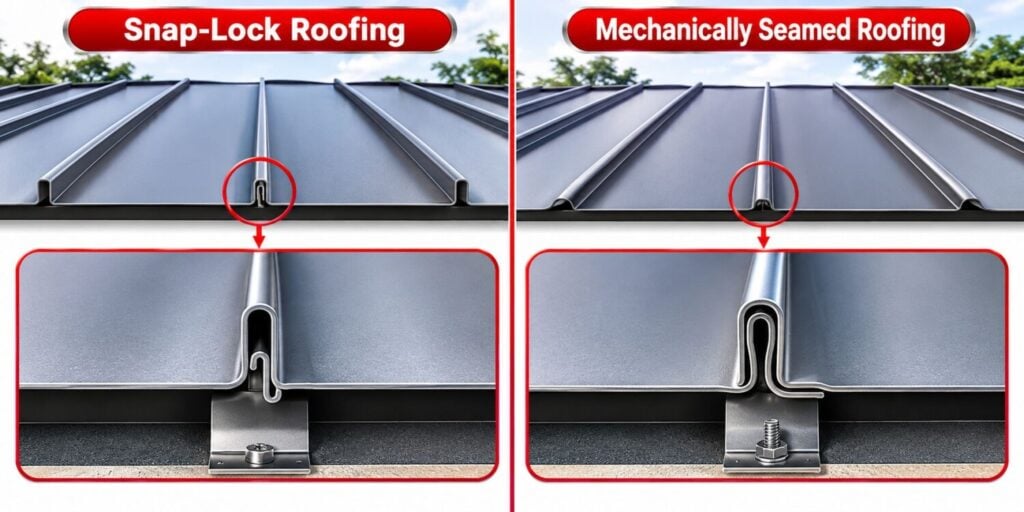
Both systems use raised panel connections and concealed fasteners, but their seam-forming methods and installation requirements differ.
| Feature | Snap-Lock Roofing | Mechanical Seam Roofing |
|---|---|---|
| Seam connection | Panels snap together | Panel edges are folded |
| Installation | Generally simpler | Requires a seaming tool |
| Labor | Usually less installation work | More specialized labor |
| Seam options | Snap-lock profile | Single-lock or double-lock |
| Roof slope | Often requires steeper slopes | Some systems support lower slopes |
| Applications | Residential and suitable commercial roofs | Residential and commercial projects |
| Cost | Often lower installation cost | Can cost more due to labor |
Which one should you choose?
Snap-lock roofing may be suitable when the roof has an appropriate slope and the selected panel meets the project’s requirements.
Mechanically seamed roofing may be a better option when the project requires a particular seam design, low-slope compatibility, or additional weather-resistance considerations.
Neither system is automatically better for every home. The correct selection should be based on the actual roof conditions and the manufacturer’s approved specifications.
What Standing Seam Metal Roof Profiles Are Available?
The standing seam profile describes the shape, height, and appearance of the raised connections between metal panels.
Different profiles can give a roof a subtle or more pronounced appearance. They can also affect panel attachment, installation requirements, and compatibility with the roof design.
Common profile features include:
| Profile feature | Description |
|---|---|
| 1-inch seam | Lower raised connection for selected panel systems |
| 1.5-inch seam | Common architectural standing seam profile |
| 2-inch seam | Taller seam profile used in various roofing applications |
| Flat pan | Smooth surface between panel seams |
| Pencil rib | Narrow, rounded raised lines |
| Striated panel | Shallow lines across the flat panel area |
| V-rib | Angular decorative panel detailing |
| Batten profile | Separate raised cap covering panel connections |
What Are Metal Roof Striations and Pencil Ribs?
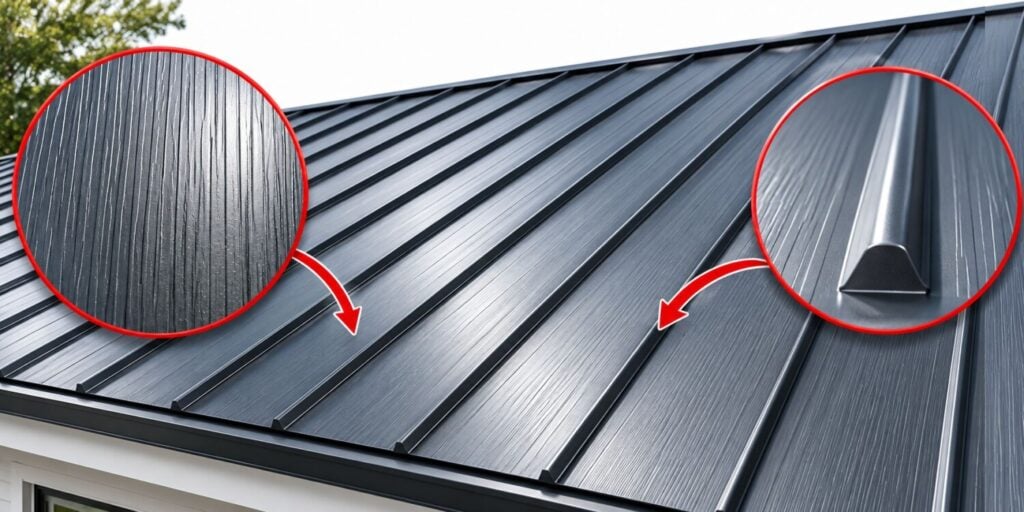
Metal roof striations are shallow lines formed into the flat area of a standing seam panel. Pencil ribs are narrower, rounded raised details that create additional texture.
These features are mainly used to change the roof’s appearance and help make visible surface waviness less noticeable.
One condition associated with metal roofing is called oil canning. It refers to waviness or slight distortion across the flat portions of metal panels.
Oil canning can be influenced by several factors, including:
- Metal thickness and panel width.
- Manufacturing and forming conditions.
- Roof deck irregularities.
- Installation and fastening methods.
- Temperature changes and material stress.
Striations and pencil ribs can help reduce the visual effect, but they cannot guarantee a completely flat panel surface.
Which profile looks best?
Flat panels create a clean, minimal appearance. Pencil ribs and striations add subtle texture, while taller seams create more visible vertical lines. The best option depends on your home’s architectural style and the overall roof design.
What Materials Are Used for Standing Seam Metal Roofing?
The metal used in a standing seam roof affects its weight, corrosion resistance, appearance, maintenance requirements, and overall project cost.
Although steel is a popular choice, homeowners can also consider aluminum, copper, and zinc. Each material has different characteristics.
| Metal material | Main characteristics | Common applications |
|---|---|---|
| Galvalume steel | Steel coated with aluminum and zinc for corrosion resistance | Residential and commercial roofs |
| Aluminum | Lightweight and naturally resistant to rust | Coastal areas and homes where lower weight matters |
| Copper | Premium appearance that develops a natural patina | Custom and architectural roofing |
| Zinc | Distinctive appearance with a naturally protective surface | High-end architectural projects |
Is Galvalume Steel a Good Choice for Standing Seam Roofing?
Galvalume steel is a popular option for standing seam metal roofing. It combines a steel base with an aluminum-zinc coating designed to improve corrosion resistance.
It offers a balance of strength, appearance, and practical performance for many residential and commercial applications.
However, the quality of the protective coating, panel thickness, finish, and installation details all matter. Homeowners should compare the specifications and warranty information of the actual roofing products rather than choosing based on the material name alone.
What Steel Thickness Is Used for Standing Seam Metal Roof Panels?
Metal thickness is commonly described using a gauge. For steel roofing, a lower gauge number generally means thicker material.
Some standing seam products are available in 22-, 24-, and 26-gauge steel. The appropriate thickness depends on the panel design, structural requirements, spacing, and manufacturer specifications.
| Steel gauge | General description |
|---|---|
| 22 gauge | Thicker steel option |
| 24 gauge | Commonly specified for various architectural applications |
| 26 gauge | Thinner option used in selected roofing systems |
What Are the Main Components of a Standing Seam Metal Roof?
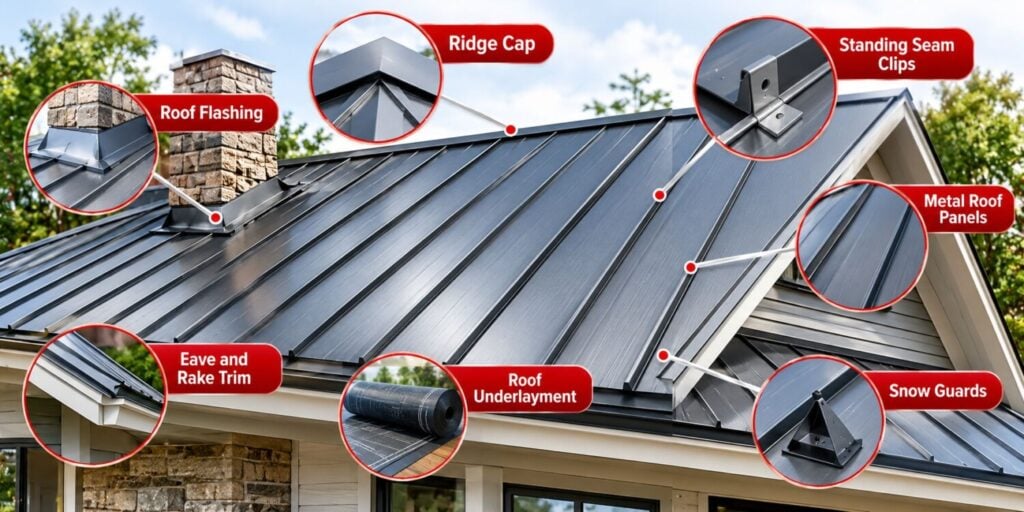
A standing seam roof is more than a collection of metal panels. Several components work together to create a complete roofing system.
Here are the important standing seam metal roof components:
1. Metal Roof Panels
These form the visible roofing surface. They are manufactured with specially shaped edges that connect to neighboring panels.
2. Standing Seam Clips
Clips attach the metal panels to the roof structure. Floating clips allow certain panels to expand and contract without being restricted by the fastening system.
3. Roof Underlayment
Underlayment provides an additional protective layer between the roof deck and the metal roofing. The product must be compatible with the selected metal roof system.
4. Ridge Cap
The ridge cap covers the upper meeting point of two roof slopes and helps protect this area from water entry.
5. Eave and Rake Trim
These metal components finish the roof edges and help direct water away from vulnerable areas.
6. Roof Flashing
Flashing is installed around chimneys, skylights, valleys, walls, and other roof transitions to help prevent water from entering the building.
7. Snow Guards
Snow guards or snow retention systems help manage the movement of accumulated snow on metal roofs. They are particularly useful where sliding snow could affect entrances, walkways, or driveways.
Every component needs to be compatible with the selected panel profile. Incorrectly matched accessories can affect drainage, panel movement, and overall roof performance.
What Are the Advantages of Standing Seam Metal Roofing?
Standing seam metal roofing offers several practical advantages compared with many traditional roofing systems. Its concealed fastening design, raised seams, and panel construction make it a popular choice for homeowners looking for a different approach to roof replacement.
1. Why Does Standing Seam Roofing Have Fewer Exposed Fasteners?
One of the main differences between standing seam roofing and conventional metal roofing is the fastening arrangement.
Exposed-fastener systems use screws that pass through the visible metal panels. Standing seam systems generally hide their fasteners beneath adjoining panels or raised seams.
This reduces the number of exposed fastening points across the main roof surface.
It also means homeowners do not have to deal with the same visible screw-and-washer pattern found on many traditional screw-down metal roofs.
2. How Do Raised Seams Help Protect Against Water?
The raised connections keep the panel joints above the main water-carrying surface.
Rainwater flows down the metal panels toward the roof edges rather than directly across the raised connections.
However, the seams alone do not make a roof completely waterproof. Proper flashing, underlayment, panel connections, roof pitch, and installation are all necessary for reliable water management.
3. Can Standing Seam Metal Roof Panels Expand and Contract?
Yes. Metal naturally changes size as temperatures fluctuate.
During warmer weather, panels expand. During colder weather, they contract.
Many clip-based standing seam systems are designed with floating clips that allow this movement along the panel length.
This is particularly important in regions like Syracuse, where roofing materials experience hot summers, freezing winters, and repeated seasonal temperature changes.
4. Does Standing Seam Roofing Improve a Home’s Appearance?
Standing seam roofing creates long, consistent vertical lines that can complement several architectural styles.
Homeowners can choose from different:
- Metal colors and finishes.
- Seam heights.
- Panel widths.
- Flat or striated surfaces.
- Steel and aluminum materials.
A dark charcoal roof, for example, can complement a modern home with light siding, while a lighter metal finish may suit a traditional architectural design.
5. Can Standing Seam Metal Roofing Support Solar Panels?
Yes. Certain standing seam systems are compatible with clamp-on solar mounting equipment.
These mounting systems attach to approved raised seams instead of requiring holes to be drilled through the roofing panels.
This can help avoid unnecessary panel penetrations. However, the clamps must be compatible with the exact panel profile and approved for the intended load.
6. Does Standing Seam Roofing Offer Energy-Efficient Options?
Some standing seam metal roofing products are available with reflective coatings that reduce solar heat absorption.
The actual energy performance depends on several factors, including:
- Roof color and finish.
- Metal coating.
- Attic insulation.
- Ventilation.
- Roof assembly and building design.
A reflective metal roof may help reduce cooling demands in certain conditions, but it does not guarantee a specific reduction in energy bills.
What Are the Disadvantages of Standing Seam Roofing?
Although standing seam metal roofing has several benefits, it also comes with limitations that homeowners should understand before choosing it.
| Potential disadvantage | What it means for homeowners |
|---|---|
| Higher initial cost | Generally costs more than many exposed-fastener metal roofs and asphalt shingles |
| Specialized installation | Requires experience with panel alignment, clips, seams, and flashing |
| Limited installer availability | Not every roofing contractor works with every standing seam profile |
| Roof pitch requirements | Some profiles cannot be installed on shallow roof slopes |
| More complicated repairs | Mechanically seamed panels may require partial seam removal and specialized repair work |
| Visible cosmetic damage | Dents, scratches, and oil canning may be noticeable on certain finishes |
Is Standing Seam Metal Roofing More Expensive?
In many cases, yes. Standing seam roofing generally has a higher upfront installation cost than basic exposed-fastener metal panels.
This is because the system may require:
- More specialized panel manufacturing.
- Concealed clips and compatible accessories.
- Additional installation labor.
- Mechanical seaming equipment for certain profiles.
- More detailed flashing and roof-edge work.
The final price depends on the roofing material, panel design, roof size, slope, complexity, removal of existing roofing, and local labor costs.
Is a Standing Seam Metal Roof Good for Syracuse Homes?
Syracuse homeowners need to consider more than the appearance of a new roof. Local weather conditions can affect the materials, fastening systems, drainage details, and overall roofing design.
Heavy snowfall, freezing temperatures, strong winds, and seasonal temperature changes make proper roof selection and installation especially important.
Here are five important considerations for Syracuse properties.
1. How Does Standing Seam Roofing Handle Heavy Snow?
Metal roofing has a relatively smooth surface, which can allow accumulated snow to slide off more easily than some other roofing materials.
However, this movement needs to be considered during the roof design.
Snow falling from a roof can create hazards near:
- Front entrances.
- Garage doors.
- Walkways.
- Driveways.
- Outdoor living spaces.
Snow guards or snow retention rails may help control where accumulated snow moves.
Their placement should be based on the roof’s slope, panel design, snow loads, and the manufacturer’s recommendations.
2. Can Standing Seam Metal Roofing Handle Syracuse Winters?
A properly selected and installed standing seam system can be suitable for cold-weather environments.
The important factors include the panel material, attachment method, flashing details, underlayment, and ability to accommodate thermal movement.
Floating clips are particularly useful in systems that require longer panels to move as temperatures change.
3. Does Roof Pitch Matter for Standing Seam Roofing?
Yes. Roof pitch is one of the most important factors when selecting a standing seam metal roof.
A panel system designed for a steep roof may not be appropriate for a low-slope section.
For example, a snap-lock panel may require a steeper roof slope, while certain mechanically seamed systems are designed for lower slopes.
Never select a standing seam profile based on its appearance alone. The manufacturer’s minimum slope requirements must be followed.
4. How Does Proper Drainage Protect a Metal Roof?
Rainwater and melting snow need a clear path toward the roof edges.
Gutters, valleys, flashing, and eave details should be designed to manage the water moving across the roofing surface.
Poor drainage can contribute to water accumulation, ice-related issues, and damage around vulnerable roof transitions.
5. Why Is Professional Installation Important in Syracuse?
Seasonal temperature changes make proper panel attachment and movement details important.
Incorrect clip placement, poorly formed seams, incompatible flashing, or inadequate roof preparation can affect the roofing system’s performance.
Working with a contractor who understands metal roofing installation can help ensure that the selected system is appropriate for your home’s structure and local conditions.
Standing Seam Metal Roof vs. Exposed-Fastener Metal Roofing: Which Is Better?
Standing seam and exposed-fastener roofing are two common types of metal roofing, but they have different construction methods.
The standing seam uses raised connections with mostly concealed fasteners, while exposed-fastener roofing uses screws that pass through the visible panel surface.
| Comparison | Standing Seam Metal Roof | Exposed-Fastener Metal Roof |
|---|---|---|
| Panel connection | Raised interlocking seams | Overlapping panel edges |
| Fasteners | Mostly concealed | Visible screws |
| Appearance | Clean vertical lines | Visible screw and rib pattern |
| Installation | More specialized | Generally simpler |
| Initial investment | Usually higher | Usually lower |
| Thermal movement | Many systems use floating clips | Depends on panel and fastening design |
| Maintenance | Seams, flashing, and finish | Screws, washers, and panel connections |
Which roofing system should you choose?
Standing seam may be worth considering if you prefer concealed fasteners, a streamlined appearance, and a system designed to accommodate panel movement.
Exposed-fastener metal roofing may be a practical alternative when upfront cost and a simpler panel design are priorities.
The right option depends on your property, budget, roof structure, and long-term expectations.
How Long Does a Standing Seam Metal Roof Last?
The lifespan of a standing seam metal roof depends on the metal material, protective coating, installation quality, weather exposure, and maintenance.
A well-designed roofing system can provide long-term service, but there is no single lifespan that applies to every standing seam product.
Factors that influence its service life include:
- Metal quality: Different metals have different corrosion-resistance characteristics.
- Protective finish: Coatings help protect the panel surface from environmental exposure.
- Installation quality: Properly formed seams, secure clips, and compatible flashing help reduce potential problems.
- Drainage: Water should move away from roof transitions and other vulnerable areas.
- Maintenance: Periodic inspections can help identify damage before it becomes more serious.
Always review the manufacturer’s warranty and product documentation for the expected performance of the specific roofing system.
How Do You Maintain Standing Seam Metal Roof Panels?
Standing seam roofing does not require the same maintenance as some traditional roofing materials, but it should not be considered maintenance-free.
Regular inspections help identify minor issues and keep the roofing system in good condition.
Here are some maintenance practices homeowners should follow:
- Inspect after severe weather: Look for visible dents, scratches, loose trim, or other damage.
- Keep gutters clear: Remove leaves and debris that can interfere with water drainage.
- Check roof flashing: Pay attention to chimneys, skylights, valleys, and roof-to-wall connections.
- Look for coating damage: Scratches and damaged finishes should be assessed to prevent potential corrosion.
- Inspect snow guards: Make sure roof-mounted snow retention accessories remain properly secured.
- Arrange professional inspections: Have a qualified roofing professional check concerns that cannot be safely assessed from the ground.
Avoid walking directly on metal roofing unless the manufacturer’s approved access instructions are followed. Incorrect foot placement can cause dents or damage the finished surface.
What Should You Check Before Installing a Standing Seam Metal Roof?
Before choosing a standing seam metal roof, compare more than the panel color or appearance. The complete roofing system should match your home’s structure, roof slope, and environmental conditions.
Use this checklist when discussing your project with a roofing contractor:
- Panel type: Confirm whether the system uses snap-lock, single-lock, double-lock, or batten-style connections.
- Metal material: Compare Galvalume steel, aluminum, copper, and other available options.
- Panel thickness: Ask about the steel gauge or aluminum thickness.
- Seam height: Check whether the selected profile is suitable for your roof design.
- Fastening system: Understand whether the panels use fixed or floating clips.
- Roof slope: Confirm the manufacturer’s minimum pitch requirements.
- Underlayment: Check that the selected underlayment is compatible with the roofing system.
- Flashing details: Review how chimneys, valleys, skylights, and roof edges will be protected.
- Snow retention: Determine whether snow guards are necessary for your property.
- Warranty: Review coverage for the metal finish, materials, and installation.
Getting clear answers to these questions can help you compare estimates and understand what is included in your new roofing system.
Frequently Asked Questions
1. What Is a Standing Seam Metal Roof?
A standing seam metal roof is a roofing system made from long metal panels connected by raised vertical seams. Most systems use concealed fasteners, giving the roof a clean appearance while reducing exposed fastening points.
2. What Are the Different Types of Standing Seam Metal Roofs?
The main types include snap-lock, mechanically seamed, batten-style, and nail-flange systems. Mechanically seamed panels are further divided into single-lock and double-lock designs.
3. Is a Standing Seam Metal Roof Better Than Regular Metal Roofing?
Standing seam roofing offers concealed fasteners and a streamlined appearance. Regular exposed-fastener metal roofing generally has a simpler installation and lower initial cost. The better option depends on your roof design, budget, and preferences.
4. What Is the Best Metal for Standing Seam Roofing?
Galvalume steel is a popular choice because it combines the strength of steel with a protective aluminum-zinc coating. Aluminum, copper, and zinc are also available for different architectural and performance requirements.
5. Can Standing Seam Metal Roofing Be Installed on a Flat Roof?
Some mechanically seamed systems are designed for low-slope applications. However, not every standing seam profile is suitable for flat or nearly flat roofs. The manufacturer’s minimum slope requirements must be followed.
6. What Is the Difference Between Single-Lock and Double-Lock Standing Seam Roofing?
A single-lock seam folds adjoining panel edges once, generally creating a 90-degree connection. A double-lock seam folds the edges twice, creating an approximately 180-degree connection. Double-lock systems are commonly used in certain low-slope applications.
7. Does a Standing Seam Metal Roof Need Snow Guards?
Not every standing seam roof needs snow guards. They may be useful when sliding snow could fall onto entrances, walkways, driveways, or other areas where people regularly walk.
How Much Does a Standing Seam Metal Roof Cost?
The cost depends on the roofing material, panel profile, metal thickness, roof size, installation complexity, and removal of existing materials. Mechanically seamed systems may also require additional labor and specialized equipment.
Standing seam metal roofing offers durability, a clean appearance, and concealed fasteners, but choosing the right system depends on your roof’s design, pitch, materials, and installation requirements. For Syracuse homeowners, proper planning is essential to handle heavy snowfall, freezing temperatures, and seasonal changes.
At Melo Roofing, we help homeowners choose suitable metal roofing systems based on their property’s needs. Contact us today to discuss your metal roofing project and request a free estimate.
