



Posted By Melo Roofing Team

16 mins

09/28/2026
The Complete Guide to Metal Roofing: Installation, Requirements & Specs
Metal roofing is a popular choice for homeowners looking for a durable, long-lasting roofing system. Available in materials such as steel, aluminum, copper, and zinc, metal roofing can provide a combination of weather protection, energy efficiency, and curb appeal.
However, installing a metal roof involves more than simply placing panels over the existing roof. The roof deck, underlayment, flashing, fasteners, ventilation, panel layout, and installation method all affect the performance and longevity of the finished system.
If you are researching how to install metal roofing, comparing metal roofing with shingles, or wondering about installation costs and requirements, this guide covers the key information you need to know.
What to Consider Before Installing a Metal Roof
Before choosing a metal roofing system, it is important to evaluate the existing roof and understand the requirements of the new installation.
Several factors can influence the right roofing solution, including:
- Condition of the existing roof deck
- Roof pitch and design
- Local building codes
- Climate and weather exposure
- Type of metal roofing
- Required underlayment
- Ventilation
- Flashing requirements
- Installation method
- Overall project budget
A professional roof inspection can help identify damaged decking, moisture problems, structural concerns, or other conditions that may need to be addressed before installation begins.
Metal Roofing Materials at a Glance
| Material | Key Characteristics | Common Considerations |
| Steel | Strong, versatile, and widely available | Usually protected with a coating to improve corrosion resistance |
| Aluminum | Lightweight and naturally corrosion-resistant | Often considered for areas exposed to moisture or salt |
| Copper | Distinctive appearance and highly durable | Generally has a higher initial cost |
| Zinc | Durable and develops a protective surface over time | Requires proper detailing and installation |
There is no single best metal roofing material for every home. The right option depends on the property’s location, design, budget, and performance requirements.
Metal Roof Installation Materials Checklist
A metal roof is a complete system made up of several components. The exact materials can vary depending on the roofing profile, manufacturer, roof design, and installation method.
| Component | Purpose |
| Metal panels or shingles | Provide the primary exterior weather barrier |
| Roof decking | Provides the structural surface beneath the roofing |
| Underlayment | Provides additional moisture protection |
| Fasteners | Secure panels to the roof structure |
| Drip edge | Helps direct water away from roof edges |
| Flashing | Protects vulnerable areas and roof transitions |
| Ridge caps | Protect the roof ridge and help finish the system |
| Closure strips | Help seal openings in certain panel profiles |
| Sealants | Provide additional protection around selected joints and penetrations |
| Ventilation components | Help manage heat and moisture in appropriate roof assemblies |
The components should be compatible with one another. Always follow the specific manufacturer’s installation instructions for the roofing product being used.
What Goes Beneath a Metal Roof?
A metal roof is supported by several layers that work together to protect the home from weather and moisture.
Understanding the Layers Under Metal Roofing
A typical metal roofing assembly may include the following:
| Roof Layer | What It Does |
| Roof Deck | Provides the structural base for the roofing system |
| Underlayment | Adds another layer of protection against moisture |
| Insulation | Helps improve the building’s thermal performance |
| Ventilation | Helps manage attic heat and moisture where applicable |
| Metal Panels | Provide the exterior weather-resistant surface |
The exact assembly can vary. Some roofs may require additional protection or specialized components based on the climate, roof design, and manufacturer’s requirements.
How Is a Metal Roof Installed? Understanding the Process
Knowing how a metal roof is installed can help homeowners understand what happens during a roofing project.
While installation methods differ between products, a typical project involves preparing the roof deck, installing underlayment and flashing, positioning the panels, securing them with appropriate fasteners, and completing the roof edges and penetrations.
Standard Metal Roof Installation Order
| Stage | What Happens |
| 1. Roof inspection | The existing roof and deck are checked for damage |
| 2. Roof preparation | Old roofing may be removed and damaged decking repaired |
| 3. Underlayment | The appropriate moisture-protection layer is installed |
| 4. Edge treatment | Drip edges and required flashing are installed |
| 5. Panel layout | Panels are measured and positioned according to specifications |
| 6. Panel installation | Metal panels are secured using the appropriate fastening system |
| 7. Flashing | Roof penetrations, valleys, walls, and transitions are properly detailed |
| 8. Finishing | Ridge caps, trim, closures, and other components are installed |
| 9. Final inspection | The completed roof is checked for installation issues |
How to Install a Metal Roof: Step-by-Step
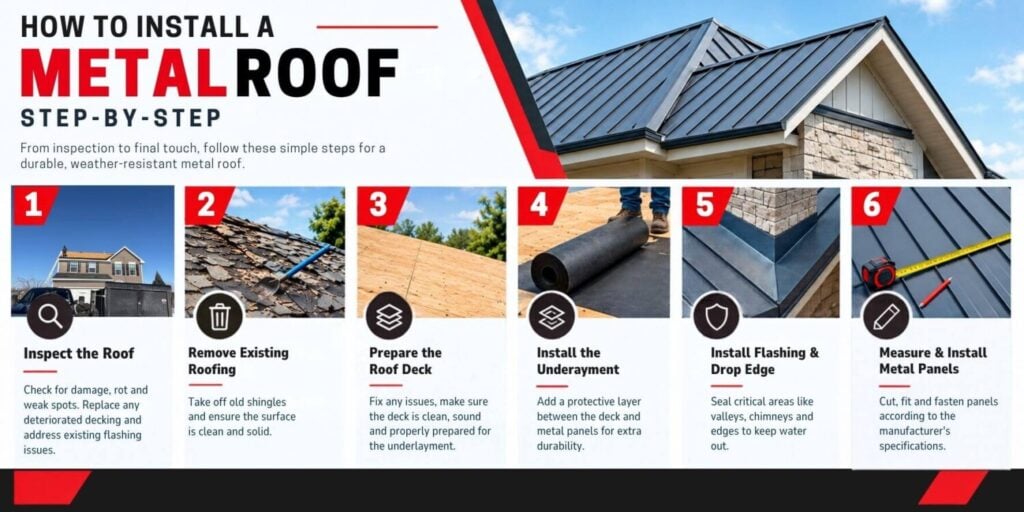
Installing a metal roof involves more than securing metal panels to a roof deck. The roof must be properly inspected, prepared, measured, and protected with the appropriate underlayment, flashing, fasteners, and finishing components. The exact installation process varies by roofing profile and manufacturer, so always follow the product’s installation instructions.
Step 1: Inspect the Existing Roof and Roof Deck
Before installation begins, inspect the roof for damaged decking, rot, moisture problems, structural concerns, and other conditions that could affect the new roofing system.
If damaged or deteriorated decking is found, it should be repaired or replaced before the metal panels are installed. The roof should also be checked for areas that may require additional flashing or other preparation.
Step 2: Remove Existing Roofing When Required
Metal roofing can sometimes be installed over existing shingles, but this depends on the condition of the existing roof, the roofing system being installed, local requirements, and the manufacturer’s instructions.
If the existing roofing is damaged, uneven, or otherwise unsuitable, removal may be necessary before installing the new system.
Step 3: Prepare the Roof Deck
Once the roof is ready, make sure the deck provides a suitable surface for the new roofing system. Any required repairs should be completed before moving forward.
A clean, sound, and properly prepared deck helps provide a stable base for the underlayment and metal panels.
Step 4: Install the Appropriate Underlayment
Install the underlayment specified for the roofing system. Underlayment provides an additional layer of protection between the roof deck and metal panels.
The correct product and installation method can vary according to the metal roofing profile, climate, roof design, and manufacturer’s requirements.
Step 5: Install Drip Edge and Required Flashing
Install the required edge treatment and flashing before or during panel installation according to the roofing manufacturer’s instructions.
Flashing is especially important around areas where the roof changes direction or where another structure or material meets the roof, including:
- Roof edges
- Valleys
- Chimneys
- Skylights
- Plumbing vents
- Wall intersections
- Other roof penetrations
Proper flashing helps direct water away from vulnerable areas and reduces the risk of water intrusion.
Step 6: Measure and Plan the Panel Layout
Accurate measurements are important before the first panel is installed. Determine the panel layout, direction, overlaps, and required cuts according to the roof’s dimensions and design.
Corrugated vs. Standing Seam Metal Roof Installation
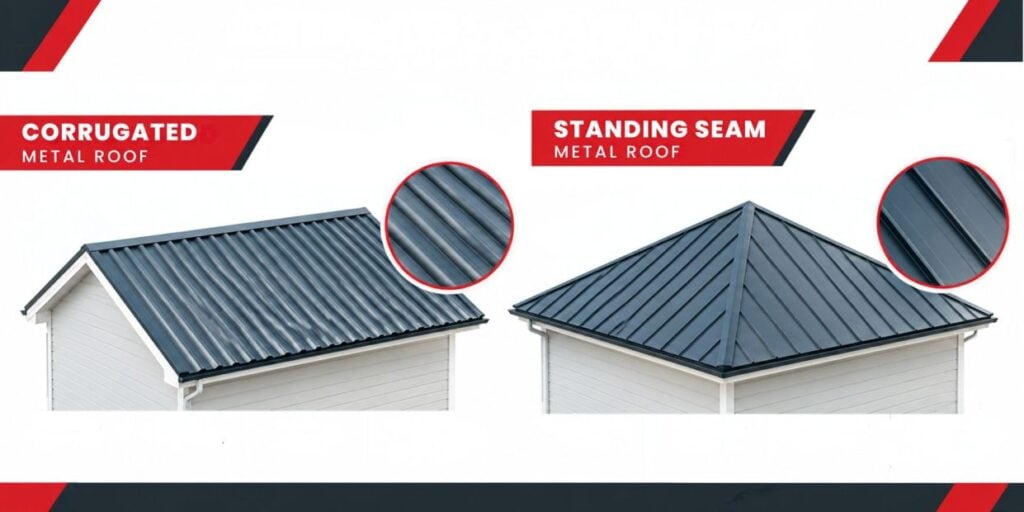
Metal roofing comes in different profiles, and installation methods can vary considerably between systems.
| Feature | Corrugated/Exposed-Fastener Roofing | Standing Seam Roofing |
| Appearance | Ribbed or corrugated profile | Clean, continuous raised seams |
| Fasteners | Often visible | Commonly concealed within the seam system |
| Installation | Generally uses overlapping panels and exposed fasteners | Requires precise panel and seam installation |
| Design options | Available in various profiles and finishes | Available in multiple finishes and panel styles |
| Thermal movement | Must be considered during installation | Particularly important in the design and installation |
| Installation expertise | Requires correct panel layout and fastening | Often requires specialized installation techniques |
Both systems can be suitable for residential applications, but the installation requirements are not identical.
Can You Put a Metal Roof Over Shingles?
A common question homeowners ask is, “Can you put a metal roof over shingles?”
In some situations, metal roofing can be installed over existing shingles. However, this depends on the condition of the existing roof, the metal roofing system, local requirements, and the manufacturer’s instructions.
Before installing over shingles, the roof should be evaluated for:
- Moisture damage
- Rot
- Uneven surfaces
- Structural problems
- Excessive existing roofing layers
- Damaged decking
- Local code restrictions
If the existing roof has significant problems, removing the shingles may be necessary before installing the new roof.
Installing a metal roof over shingles should never be treated as a way to hide an underlying roofing problem.
Metal Roof Installation Requirements and Specifications
Proper installation requires attention to technical specifications. These specifications vary by product, manufacturer, roof design, and local requirements.
Roof Pitch
Different metal roofing systems have different minimum slope requirements. A roofing product designed for one application may not be suitable for a low-slope roof.
Panel Overlap
Panels need to overlap correctly to help prevent water from entering between sections. The required overlap depends on the specific panel profile and manufacturer instructions.
Fastener Placement
Fasteners should be installed in the locations and spacing specified by the manufacturer.
Incorrect placement can affect the panels’ ability to withstand weather conditions and may contribute to leaks or other problems.
Underlayment
The underlayment should be appropriate for the roofing system and installed according to the product requirements.
Flashing
Flashing needs to be properly integrated around roof penetrations, valleys, walls, chimneys, and other transitions.
Ventilation
Proper attic ventilation can help manage heat and moisture. The ventilation approach should be designed as part of the overall roof assembly.
Building Codes
Local building codes may establish requirements for roofing materials, wind resistance, fire performance, ventilation, structural considerations, and installation.
Homeowners should verify applicable requirements before starting a roofing project.
How Much Does a Metal Roof Cost?
How much does a metal roof cost?
The answer depends on the individual project.
Metal roofing costs can vary based on the material, roof size, labor, roof complexity, existing roofing, and additional components required for installation.
Factors That Affect Metal Roof Cost
| Cost Factor | How It Can Affect the Project |
| Roof size | Larger roofs require more materials and labor |
| Metal type | Different metals have different material costs |
| Roof design | Complex roofs generally require more labor and detailing |
| Roof pitch | Steeper roofs can require additional safety measures and labor |
| Existing roofing | Removal and disposal can add to project costs |
| Roof deck condition | Repairs or replacement can increase the total |
| Underlayment | Different systems require different underlayment products |
| Flashing | Complex roof features may require additional flashing |
| Labor | Installation requirements vary by roofing system |
| Accessories | Trim, vents, closures, fasteners, and other components contribute to the final cost |
Rather than comparing only the price per square foot, homeowners should compare the complete scope of work included in each roofing estimate.
How Long Does a Metal Roof Last?
One of the biggest reasons homeowners consider metal roofing is its potential for a long service life.
A properly selected, installed, and maintained metal roof can last for several decades. The actual lifespan depends on the metal, protective coating, environmental exposure, installation quality, maintenance, and other factors.
Factors That Influence Metal Roof Lifespan
- Quality of the roofing material
- Protective coating
- Installation quality
- Local climate
- Moisture and salt exposure
- Maintenance
- Proper drainage
- Ventilation
- Condition of the underlying roof structure
A roof that is installed correctly and maintained regularly is better positioned to deliver its expected service life.
How Long Does It Take to Install a Metal Roof?
There is no universal installation timeframe because every roofing project is different.
A small, straightforward roof may require considerably less time than a large or complex roof with multiple sections, valleys, skylights, chimneys, or other penetrations.
Factors That Affect Installation Time
| Factor | Potential Impact |
| Roof size | Larger roofs generally require more installation time |
| Roof complexity | Multiple sections and roof features add work |
| Existing roofing | Removal can extend the project |
| Roof deck repairs | Damaged decking must be repaired before installation |
| Roofing system | Different systems require different installation methods |
| Weather | Rain, wind, or other conditions can delay work |
| Crew size | Larger crews may complete suitable projects more quickly |
| Material availability | Delays in materials can affect scheduling |
A roofing contractor can provide a more accurate project timeline after inspecting the roof and determining the scope of work.
Common Metal Roofing Installation Mistakes to Avoid
Metal roofing is durable, but improper installation can reduce its performance and create avoidable problems.
Using the Wrong Fasteners
Fasteners need to be compatible with the roofing material and installation environment. Incorrect fasteners can contribute to corrosion, movement, or leaks.
Incorrect Panel Overlap
Panels that are not overlapped according to manufacturer requirements may allow water to enter the roofing system.
Poor Flashing Installation
Flashing is essential around roof penetrations and transitions. Improperly installed flashing can lead to water intrusion.
Skipping Required Underlayment
Depending on the roofing system, underlayment may be an important part of the roof assembly. It should not be omitted when required by the product or applicable requirements.
Incorrect Fastener Tightening
Over-tightened screws can damage washers or panels, while loose fasteners may not provide the required connection.
Ignoring Thermal Movement
Metal expands and contracts as temperatures change. Roofing systems should be installed in a way that accommodates movement according to the manufacturer’s specifications.
Failing to Follow Manufacturer Instructions
Different metal roofing products can have different requirements. Following the manufacturer’s installation instructions is essential.
Metal Roof vs. Shingles: What Is the Difference?
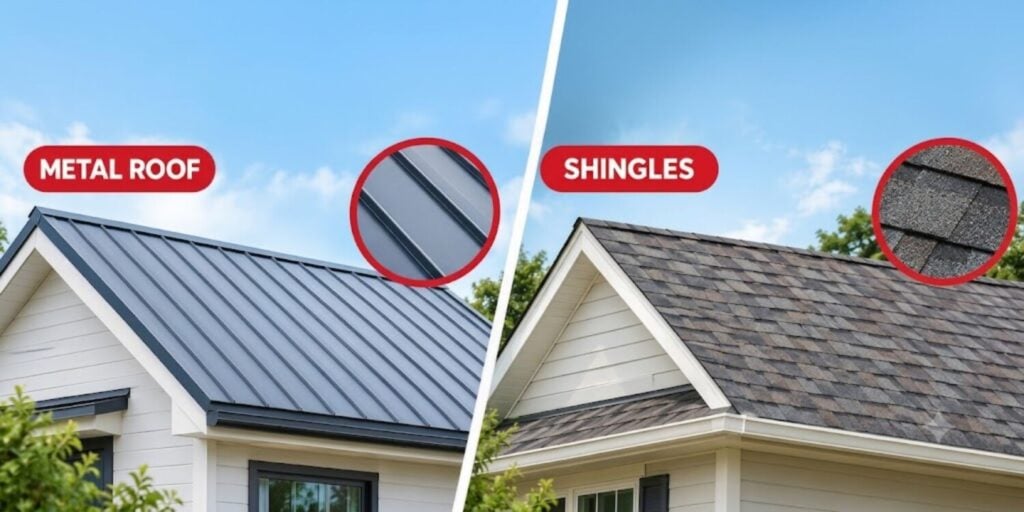
Metal roofing and asphalt shingles each have different characteristics. The right choice depends on the homeowner’s goals, property, budget, and expected service life.
| Feature | Metal Roofing | Asphalt Shingles |
| Typical service life | Generally longer | Generally shorter |
| Initial cost | Often higher | Often lower |
| Maintenance | Usually relatively low | Requires periodic inspection and maintenance |
| Material options | Steel, aluminum, copper, zinc, and more | Primarily asphalt-based products |
| Appearance | Multiple profiles and finishes | Wide range of colors and styles |
| Installation | Requires product-specific techniques | Widely used installation methods |
| Energy performance | Some finishes can reflect solar energy | Varies by product and roof assembly |
| Durability | Designed for long-term weather exposure | Performance varies by shingle type and conditions |
Instead of asking whether one material is universally better, homeowners should consider which roofing system best matches their home’s requirements.
Advantages and Potential Drawbacks of Metal Roofing
Benefits of Metal Roofing
Metal roofing can offer several advantages:
- Long service life
- Durable construction
- Resistance to many weather conditions
- Multiple styles and colors
- Potential energy-efficiency benefits
- Relatively low routine maintenance
- Availability in recyclable materials
- Resistance to fire for many metal roofing products
Potential Drawbacks to Consider
Metal roofing can also have considerations that homeowners should understand before making a decision:
- Higher initial investment for some systems
- Installation can require specialized knowledge
- Some systems may transmit more rain or hail noise
- Scratches or coating damage may require repair
- Thermal expansion and contraction need to be considered
- Certain materials may require additional corrosion protection depending on the environment
Are Metal Roofs Noisy?
Metal roofing is sometimes associated with increased noise during heavy rain or hail.
However, the amount of sound that reaches the interior depends on the entire roof assembly. Roof decking, insulation, underlayment, attic construction, and ceiling materials can all influence sound transmission.
Properly designing the complete roofing assembly can help manage unwanted noise.
Do Metal Roofs Rust?
Whether a metal roof rusts depends largely on the material, coating, installation, and environmental exposure.
Steel roofing is commonly manufactured with protective coatings that help resist corrosion. Aluminum, copper, and zinc have different corrosion characteristics.
Potential contributors to corrosion can include:
- Damaged protective coatings
- Persistent moisture
- Salt exposure
- Incompatible metals
- Poor drainage
- Improper installation
Regular inspections can help identify coating damage, corrosion, or other concerns before they become more serious.
Are Metal Roofs Energy Efficient?
Metal roofing can contribute to energy efficiency, particularly when the roofing material has a reflective finish that helps reduce solar heat absorption.
However, the roof itself is only one part of a home’s energy performance.
| Factor | Why It Matters |
| Roof color and finish | Can influence solar heat absorption |
| Insulation | Helps reduce heat transfer |
| Attic ventilation | Helps manage heat and moisture |
| Roof assembly | Affects overall thermal performance |
| Windows and doors | Can significantly affect whole-home energy use |
For this reason, are metal roofs energy efficient? is best answered by considering the entire building rather than the roofing material alone.
How to Maintain a Metal Roof
Although metal roofing generally requires relatively little maintenance, periodic inspections can help identify issues early.
Metal Roof Maintenance Checklist
| Maintenance Task | Why It Matters |
| Inspect panels | Helps identify damage or coating issues |
| Check fasteners | Loose or damaged fasteners may need attention |
| Inspect flashing | Helps identify potential water-entry points |
| Remove debris | Prevents debris from interfering with drainage |
| Clean gutters | Helps maintain proper water drainage |
| Check for corrosion | Allows problems to be addressed early |
| Inspect after severe weather | Helps identify storm-related damage |
Homeowners should also follow the roofing manufacturer’s maintenance recommendations.
When Should You Hire a Professional Metal Roofing Contractor?
Metal roof installation involves more than attaching panels. Correct measurements, flashing, fastener placement, panel alignment, roof safety, and knowledge of the particular roofing system are all important.
A professional contractor can:
- Inspect the existing roof
- Identify structural or moisture concerns
- Recommend an appropriate roofing system
- Calculate material requirements
- Install underlayment and flashing
- Follow manufacturer specifications
- Address complex roof details
- Help ensure applicable requirements are followed
DIY vs. Professional Installation
| Consideration | DIY Installation | Professional Installation |
| Initial labor expense | May reduce labor costs | Includes professional labor |
| Technical experience | Requires significant knowledge | Contractor brings installation experience |
| Roof safety | Homeowner assumes the risk | Professional crews use established safety practices |
| Complex roof details | Can be challenging | Contractors can handle specialized details |
| Manufacturer requirements | Homeowner must understand them | Experienced installers are familiar with product requirements |
| Repairs and corrections | May require additional work if mistakes occur | Installation is handled by the contractor |
For complex roofs, steep slopes, standing seam systems, or projects requiring structural repairs, professional installation can be particularly important.
Frequently Asked Questions
What Are the Main Types of Metal Roofing?
Common types include corrugated panels, exposed-fastener systems, standing seam roofing, and metal shingles. Available styles depend on the manufacturer and application.
What Is the Best Metal Roofing Material?
There is no universal answer. Steel, aluminum, copper, and zinc each have different characteristics, costs, appearances, and corrosion properties.
How Do You Install Steel Roofing?
Steel roofing is generally installed by preparing the roof deck, installing the appropriate underlayment and flashing, positioning the panels, securing them with specified fasteners, and completing the ridge, edges, and roof penetrations. The exact method depends on the steel roofing system.
How to Install a Metal Roof?
A typical installation involves inspecting the roof deck, preparing the surface, installing underlayment and flashing, laying out the panels, securing them according to manufacturer specifications, and completing all edges, seams, and penetrations.
Can You Put a Metal Roof Over Shingles?
In some cases, yes. The existing shingles and roof structure must be evaluated, and the installation must comply with applicable requirements and the manufacturer’s instructions.
How Long Does a Metal Roof Last?
A properly installed and maintained metal roof can provide several decades of service. Actual lifespan depends on the material, coating, climate, installation quality, and maintenance.
How Long Does It Take to Install a Metal Roof?
Installation time depends on roof size, complexity, existing roofing, material type, weather, roof condition, and crew size.
How Should a Metal Roof Be Maintained?
Regular maintenance includes inspecting panels, fasteners, flashing, and roof penetrations; removing debris; maintaining gutters and drainage; and checking for coating damage or corrosion.
Final Thoughts
Choosing the right roofing system is essential for long-lasting performance. A metal roof can provide durable, reliable protection when properly installed and maintained. Proper roof deck preparation, the correct underlayment and fasteners, and quality flashing are also important for dependable results.
Melo Roofing provides metal roofing, roof replacement, roof repair, and shingle roofing for homeowners and businesses. Before starting a project, consider the roof condition, installation requirements, material, cost, and maintenance needs. For complex roofing projects, an experienced contractor can help ensure the system is installed correctly and performs reliably for years to come.
